
Why Most Lawn & Landscape Companies Fail Even With Great Marketing

Summary
Plenty of lawn and landscaping companies invest in good marketing and still feel stuck. Not because marketing is pointless, but because marketing is an amplifier. If the fundamentals are strong, marketing accelerates growth. If the fundamentals are weak, marketing exposes the cracks faster and more publicly. This article explains why that happens, what priorities actually build scale (or stable profitability), how to audit your infrastructure, and how to set simple KPIs that reveal the truth.
Marketing Is an Amplifier, Not a Rescue Plan
Most owners invest in marketing because they want relief. More calls, more leads, more booked work, and less stress about what next month looks like. That’s a reasonable goal, but it often comes with an unrealistic expectation: that marketing fixes the business.
In reality, marketing increases exposure. It introduces your company to more people, more often, with more urgency. It does not automatically create sales capacity, tighten follow-up, speed up estimates, or build trust. It simply shines a brighter light on whatever your business already is.
When the fundamentals are strong, marketing creates momentum
When your business consistently books appointments, sends estimates quickly, and follows up like it actually wants the work, marketing becomes leverage. More demand turns into more booked work. More booked work turns into predictable revenue. Predictable revenue turns into the confidence to hire, add equipment, and expand without gambling your cash flow.
This is why two companies can run similar marketing strategies and get completely different outcomes. The difference is not a secret platform trick. The difference is what happens after the lead comes in.
When the fundamentals are weak, marketing exposes the business
If your business misses calls, takes too long to provide bids, forgets follow-up, and lets reviews sit dormant, marketing will expose those weaknesses. The market responds, but the business doesn’t. Owners experience it as “marketing isn’t working,” because now the pain is louder and more frequent.
Marketing did not cause the problem. Marketing revealed the problem by creating opportunities your current systems cannot capture.
Marketing amplifies business character
Homeowners do not just experience your ads. They experience your responsiveness, professionalism, clarity, consistency, and trustworthiness. Marketing amplifies those traits because it increases the number of people who interact with them.
If your company is organized and responsive, marketing makes that feel obvious in the market. If your company is chaotic and slow, marketing makes that obvious too.
The Fundamentals That Decide Whether Leads Become Revenue
We’ll say this plainly: the fundamentals can sound obvious. Sometimes it feels silly to say them out loud. Answer the phone. Send estimates quickly. Follow up. Collect reviews. Keep clean data.
But as an agency, we are not saying this as philosophy. We say it because we can see what’s happening across real businesses. When a company says marketing is failing, the answer is often hidden in lead handling, not lead generation.
The numbers can be shockingly bad, and they are not rare
We have seen answer rates so low the business is effectively closed during parts of the day. We have seen review activity go stale for years. We have seen estimate turnaround times measured in days when the market expects hours. We have seen follow-up that is “hope-based,” meaning it happens only when someone remembers.
None of this is said to shame anyone. It’s said because these fundamentals are the difference between profitable growth and expensive chaos.
Fundamentals are not just habits, they are systems
Most owners are not neglecting fundamentals because they don’t care. They are busy, overloaded, and trying to keep production moving. That’s exactly why systems matter. A simple, repeatable process beats good intentions every time.
If the business relies on memory, it will break under growth. If the business relies on a system, marketing can safely increase volume.
Clean definitions and clean data are part of fundamentals
If one team member labels a lead “spam,” another labels it “not qualified,” and another leaves it “pending forever,” the business loses the ability to learn from reality. Reporting becomes confusing, decisions get emotional, and marketing gets blamed by default.
If your business wants predictability, your pipeline language must be consistent and your lead statuses must mean something.
The Scaling Priority Stack for Owner-Operators
Owner-operators are often the best producer on the team, which creates a trap. Production becomes priority number one, and everything else becomes “when we have time.”
If the goal is to scale, production cannot stay at the top forever. The business must prioritize what turns opportunities into booked work, then build production capacity underneath that demand.
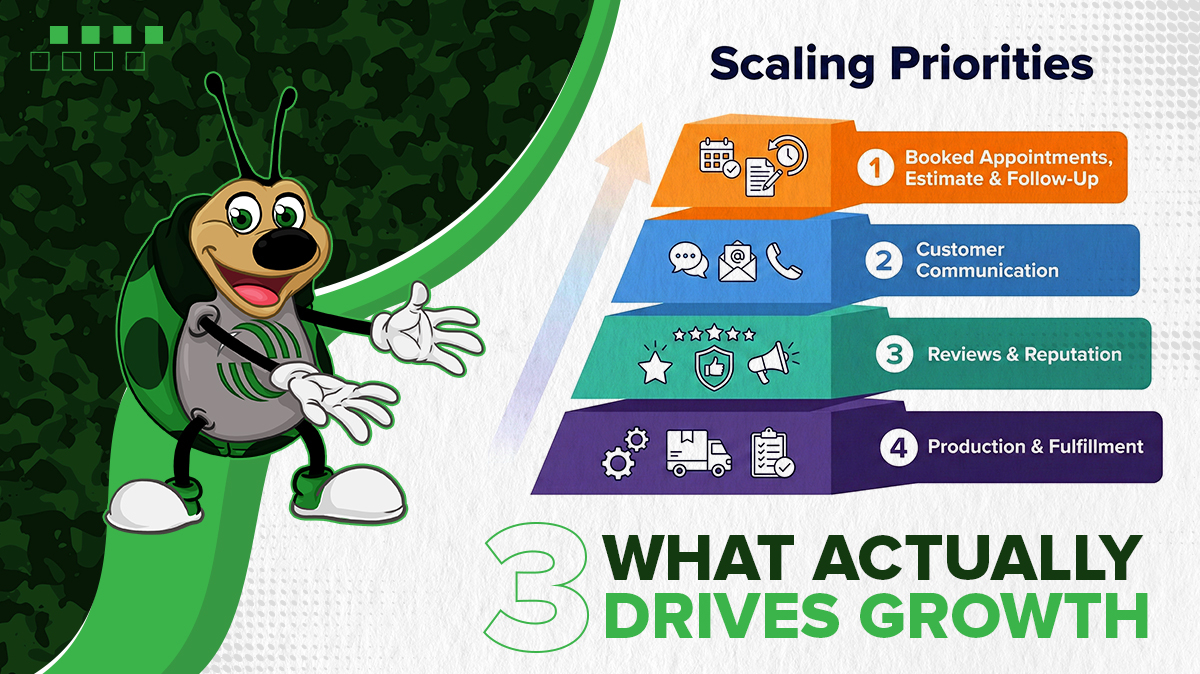
Priority #1: Booked appointments, estimates, and follow-up
This is the revenue engine. Leads only matter if they become booked appointments. Booked appointments only matter if they become estimates. Estimates only matter if they are followed up and converted.
If this part of the business is inconsistent, marketing becomes a revolving door. Your schedule becomes unstable, your team becomes reactive, and your profitability gets squeezed because you keep accepting whatever falls into your lap instead of choosing the work you want.
Priority #2: Customer communication
Customer communication is more than being friendly. It’s clarity, speed, professionalism, and confidence. It sets expectations, reduces misunderstandings, and helps you win higher-ticket work because the customer feels safe choosing you.
Good communication is also what protects trust when life happens. Weather changes, supply delays, and schedule adjustments are normal. Communication is what keeps them from becoming refunds and bad reviews.
Priority #3: Reviews and reputation momentum
Google reviews are one of the most important assets you can build because they influence every major Google surface that drives demand.
They help you rank in the Local Map Pack and on your Google Business Profile. They increase click-through and conversion because the market trusts volume and recency. They support website SEO by reinforcing local authority and brand credibility signals. They can even impact ad performance by improving trust and engagement signals that lead to better conversion rates, which influences what it costs to acquire customers and how competitive your ad placement can be.
In short, reviews are not just reputation. They are a ranking and conversion lever across the entire Google ecosystem.
Priority #4: Production and fulfillment
Production is essential, but it cannot be the reason the sales engine collapses. When production is always first, calls get missed, estimates get delayed, and follow-up disappears. That creates a loop where the business stays busy without compounding.
The path forward is building a process that protects sales activity and then hiring, training, and scheduling production to match the demand you’re generating.
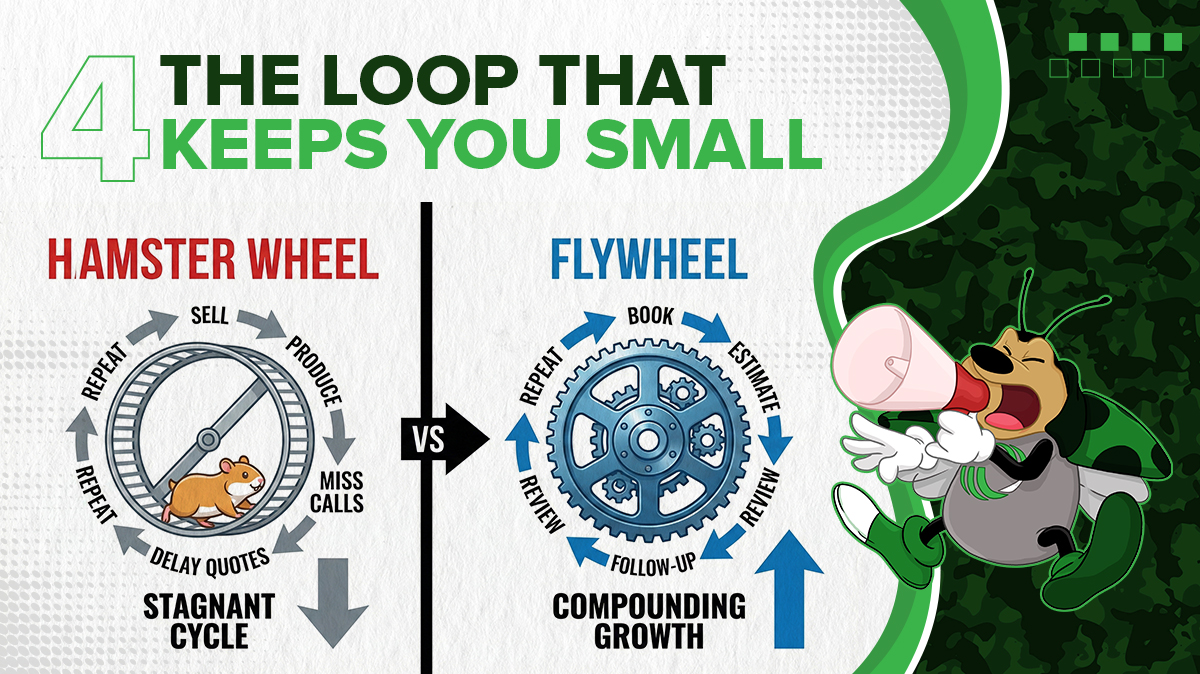
The Hamster Wheel Problem and Why “Busy” Is Not the Same as Growth
Many contractors get trapped in a loop that feels productive. You sell a job, you go produce the job, and while you’re producing, new leads come in and you miss them. Then you finish the job, scramble to catch up, and repeat.
This is the hamster wheel. It keeps you moving, but it does not compound. The business stays fragile because the system depends on you doing everything at once.
Decide your ambition before you build your plan
Not every owner wants to scale into multiple crews. Some owners want to stay small and very profitable, with a tight route, premium pricing, and less stress. That’s valid.
But here’s the truth: whether you want to scale or stay small, fundamentals still matter. Small and profitable requires strong fundamentals so you can be selective and keep your schedule stable without desperation.
Scaling requires different priorities than “getting through the week”
If you want to scale, you must protect sales activity like it’s production. Because it is. The work your crews do next month is created by booked appointments, fast estimates, and consistent follow-up this week.
If you keep production as the permanent top priority, the ceiling stays low, even if marketing improves.
How to Analyze Your Existing Infrastructure
The fastest way to stop guessing is to audit your infrastructure. Not your “feelings.” Not your assumptions. Your actual operational reality.
This does not need to be complicated. A simple weekly review of a few areas will reveal exactly where marketing is being amplified and where it is being leaked.
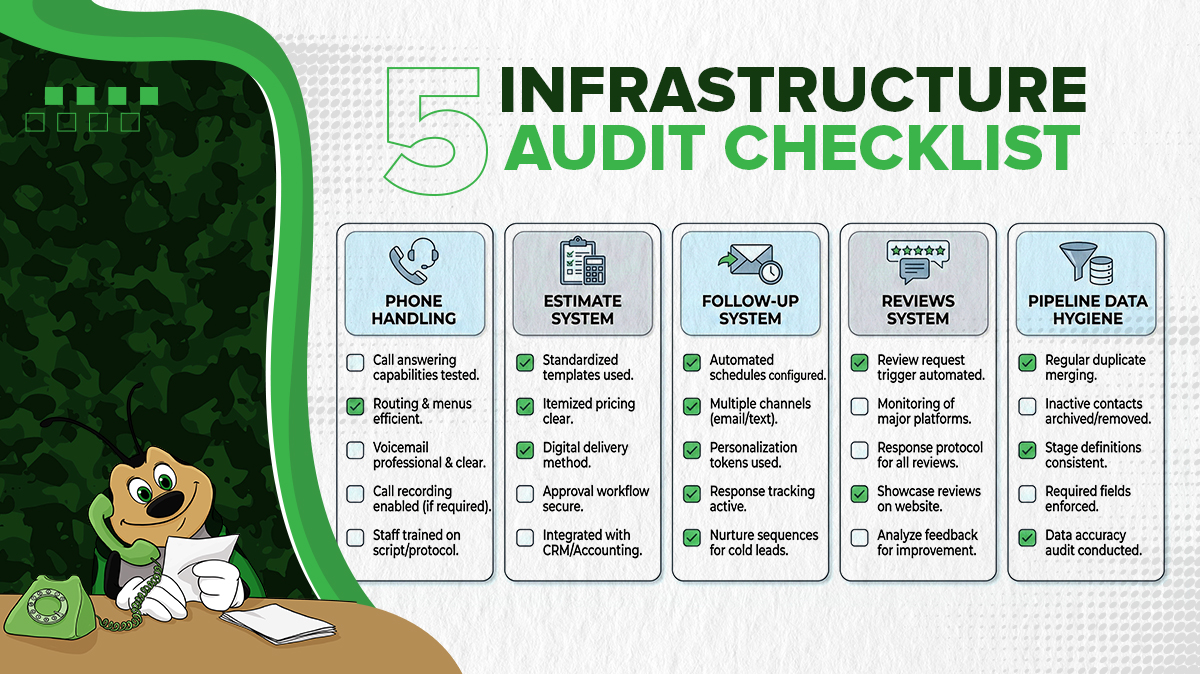
Audit your phone handling like it’s payroll
Pull call logs and ask simple questions: How many calls were missed? How fast was the first response? What happens when you are in the field?
If you do not have a clear answer, that’s the first infrastructure gap. You can’t improve what you refuse to measure.
Audit your estimate process for speed and clarity
Track the time from first contact to quote delivered. Then look at quote quality. Is it clear? Is it professional? Does it set expectations? Does it include a next step?
Speed wins, but clarity keeps you from getting the wrong customers. Your estimate process is both a sales tool and a filter.
Audit your follow-up cadence for consistency
How many touches happen after the estimate is sent? Do you have a clear cadence, or do you “check in” when you remember?
Most jobs are lost silently. Not because the customer hated you, but because someone else stayed present and you disappeared.
KPIs That Reveal the Truth
You don’t need 40 metrics. You need a few that expose reality without debate. KPIs are not about judgment, they are about truth. When you know the truth, you can fix the right thing.
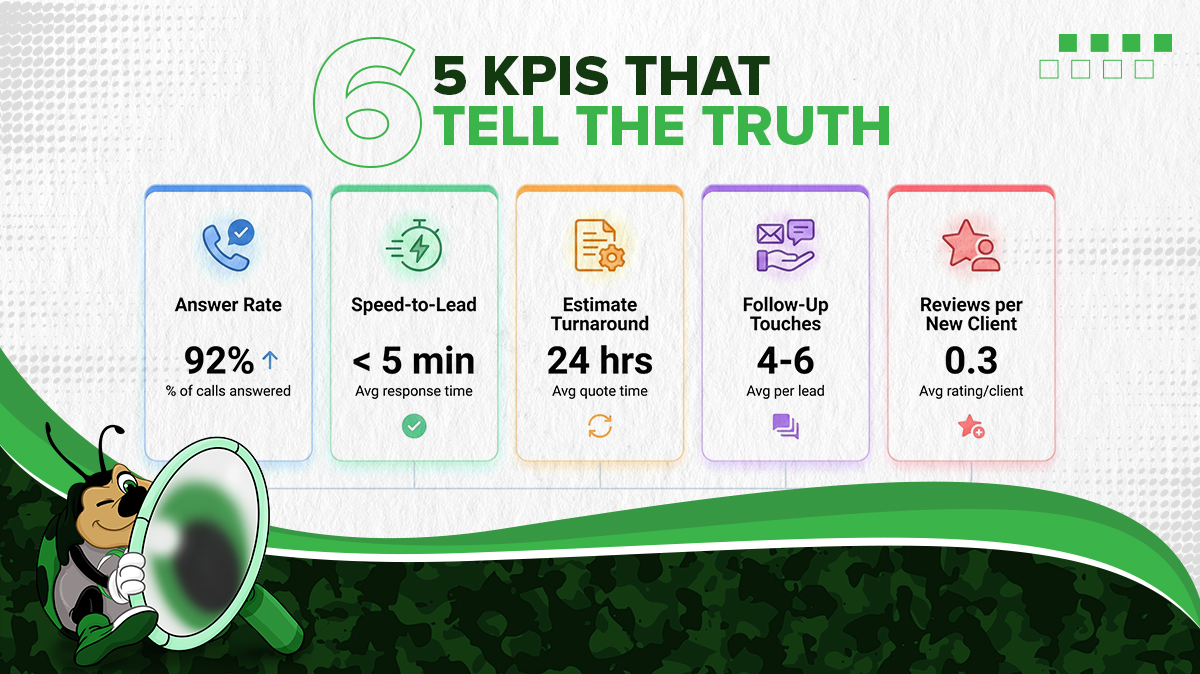
KPI #1: Call answer rate
This is the first conversion gate. If your answer rate is low, marketing will always feel expensive because you’re paying to generate opportunities you never speak to.
KPI #2: Speed-to-lead
How quickly do you respond to a new lead during business hours? Minutes matter. Speed is a competitive advantage, and it’s one of the easiest ways to win more without increasing marketing spend.
KPI #3: Estimate turnaround time
Track the time from lead to quote delivered. If your market is competitive, slow quotes create a silent loss pile that looks like “marketing didn’t work.”
KPI #4: Follow-up touches per estimate
Pick a standard, then measure it. A simple cadence beats random check-ins. Most companies under-follow-up, and they underestimate how much revenue lives there.
KPI #5: Reviews per new client conversion rate
Instead of only counting reviews per month, tie reviews to growth. Track how many new clients you close, then track how many reviews you generate from those wins. This reveals whether reviews are a system or a random event.
If you close 20 new clients in a month and you only get 1 review, your review request process is not real yet. If you close 20 and you get 10, you are building a compounding advantage that directly supports rankings and conversion across Google.
Systems, Automation, and Why CRMs Matter More Than Most Owners Realize
A CRM is not just a place to store leads. When used correctly, it becomes your consistency engine. Most CRMs can automate reminders, follow-up sequences, estimate workflows, pipeline stages, and review requests.
The problem is that many businesses either don’t use the CRM, or they use it like a digital notepad. That’s wasted leverage.

Automate what you keep forgetting
If you constantly forget to follow up, request reviews, or update lead statuses, automation is your friend. Use your CRM to trigger tasks, reminders, and messages. Let the system do the remembering so you can do the leadership.
Make review requests part of your closeout process
Most CRMs support automation that sends a review request after a job is completed. That can be triggered by moving a job to “completed,” generating an invoice, or marking a project as closed.
This removes friction and turns reviews into a predictable outcome of a good customer experience.
AI receptionists will become a major unlock
Phone handling is a massive bottleneck in this industry because owners are in the field. That’s why AI receptionists and intelligent call handling will become one of the most powerful innovations contractors adopt. They won’t replace your business. They will protect your fundamentals by capturing calls, qualifying intent, booking appointments, and reducing missed opportunities when you are busy.
The goal is not to be fancy. The goal is to stop bleeding leads.
Don’t Fire the Marketing Pillar to Avoid Fixing Fundamentals
We’ll say it clearly: there are unlimited poor-performing marketing agencies out there. Contractors have every reason to be skeptical, and nobody should tolerate weak execution or vague reporting.
At the same time, there’s a pattern we see too often. A business finally gets decent marketing, then fires the agency because results are not showing up in the bank account. Before you blame the agency, you have to look deeper into the reports and ask the right question: how are the leads being handled?

This is not an excuse for weak marketing agencies
If an agency cannot show lead volume, lead quality, and clear performance trends, that’s a problem. If they hide behind impressions and clicks without connecting to leads and sales, that’s also a problem.
You deserve real reporting, and you deserve a partner who understands your industry.
If the agency isn’t reporting on lead handling, they are not setting you up
A marketing report that ignores call answer rate, speed-to-lead, estimate speed, follow-up, and reviews is incomplete. It leaves you blind to the biggest reason marketing “doesn’t work” in home services: operational leakage.
Even if the agency is doing good work, you will still feel frustrated because you can’t see what’s actually happening after the lead comes in.
We put a spotlight on the elephant so growth can be explosive
Our approach is to expose reality so you can fix it. We are not successful unless you are successful. That means we can’t pretend the fundamentals don’t matter. If call handling is weak, we will talk about it. If follow-up is inconsistent, we will talk about it. If reviews are stalled, we will talk about it.
Instead of ignoring the elephant in the room, we put a spotlight on it so you can accept the issue for what it is and put a solution in place. That’s how good marketing turns into explosive growth.
Build Your Fundamentals Faster Through Peer Perspective
One of the fastest ways to improve fundamentals is to get around other owners who are actively solving the same problems. This industry has unique constraints: seasonality, weather, field production, staffing, and customer expectations. Generic business advice often misses the mark.
Peer perspective creates shortcuts. You see how another owner handles call coverage. You learn their follow-up cadence. You adopt their review process. You stop feeling like you’re the only one dealing with the chaos.

Why we built Landscaping Business Success
That’s why we have our sister company, Landscaping Business Success. It’s a free mastermind-style group for lawn and landscapers, focused on education, implementation, and connection. The goal is to elevate the industry as a whole by giving owners a place to learn what works and build relationships with people who get it.
If you want that environment, you can join here:
You are not behind, you are just missing a system
There’s no reason to feel ashamed or hopeless. Nearly every company in this industry deals with the same bottlenecks. The difference is not talent. The difference is whether you’re willing to face reality and install the system.
Stay solution-focused. If some random guy named Jim Bob can improve his answer rate, tighten his follow-up, and build a review engine, you can too.
Conclusion
Great marketing is an amplifier. When your fundamentals are strong, marketing can explode growth and create momentum that compounds year after year. When your fundamentals are weak, marketing will expose the cracks faster, and it will feel like marketing is failing even when the market is responding.
For owner-operators, production-first thinking often creates a hamster wheel. It feels productive, but it doesn’t scale. Whether you want to grow into multiple crews or stay small and very profitable, the path forward still runs through the same fundamentals: booked appointments, fast estimates, consistent follow-up, strong customer communication, and steady review momentum that impacts every Google platform.
If you want a simple next step, run a 7-day truth audit: call answer rate, speed-to-lead, estimate turnaround time, follow-up touches per estimate, and reviews per new client conversion rate. Fix one constraint at a time. When fundamentals improve, marketing stops being a gamble and becomes leverage.
Other Blogs
How Google’s New AI Pricing Calls Will Change Leads For Lawn And Landscape Companies
Share on Social Table of Contents Google Business Profile (GBP) Google Local Service Ads (LSAs) Custom Website & SEO Other Summary Google is rolling out a feature that lets...
What To Do When Your Google Reviews Disappear – Lawn and Landscape Edition
Share on SocialTable of Contents Google Business Profile (GBP) Google Local Service Ads (LSAs) Custom Website & SEO Other Summary If your Google reviews have suddenly disappeared or...
Best Way To Get Leads For Lawn & Landscape Businesses
Share on SocialTable of Contents Google Business Profile (GBP) Google Local Service Ads (LSAs) Custom Website & SEO Other Introduction As a niche-based marketing agency, we are always...